Press release
Looking back at PCNW 2025
In October 2025, the first edition of Paris Climate & Nature Week brought together more than 4,000 participants and 300 speakers across 60 events held at Sciences Po, marking the tenth anniversary of the Paris Agreement.
Governments, businesses, investors, researchers, civil society organisations and citizens came together with a shared ambition: to identify opportunities for collective responses and strengthen cooperation to accelerate the ecological transition.
Over several days, the programme explored the many dimensions of the transformation required, from international climate cooperation to the choices that shape our everyday lives, including those related to work, mobility, investment and health. Particular attention was given to climate governance, at a time when geopolitical tensions and shifting international dynamics are making cooperation both more essential and more challenging.
At Sciences Po, discussions offered valuable insights into the geopolitical dimensions of the transition, while bringing scientific perspectives to the fore.
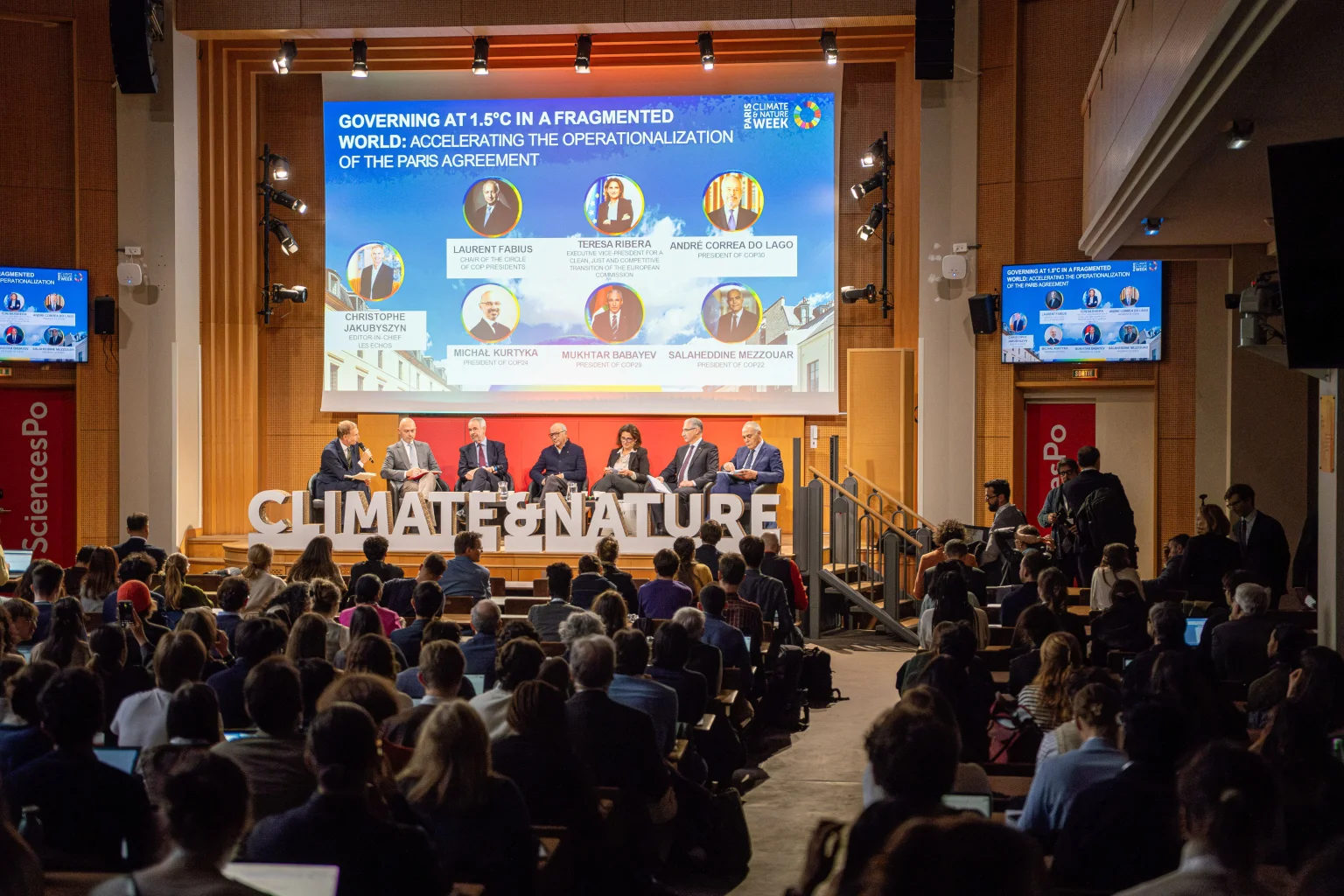
A high-level conference entitled “Governing at 1.5°C in a Fragmented World: Accelerating the Operationalization of the Paris Agreement” brought together several figures who had presided over Conferences of the Parties (COPs), including Laurent Fabius, André Corrêa do Lago, Teresa Ribera, Michał Kurtyka, Mukhtar Babayev and Salaheddine Mezouar. Moderated by Christophe Jakubyszyn, editor-in-chief of Les Échos, the event offered an opportunity to reflect on the ten years since the adoption of the Paris Agreement and examine ways to turn international commitments into concrete action. Discussions highlighted the political, institutional and financial conditions needed to keep the 1.5°C goal within reach and accelerate the implementation of climate commitments, despite a fragmented international landscape.
Public support and the social conditions needed for the transition were also central themes. A citizens’ assembly explored the role of citizens in the ecological transformation.
Building on these reflections, a roundtable organised by Sciences Po’s Paris Climate School examined the growing environmental backlash in France and Europe. Opposition to climate policies, regulatory rollbacks, polarisation of public debate and discontent among sectors dependent on fossil fuels: speakers analysed the drivers of these tensions and examined how the transition is being implemented. A key question emerged from the discussions: beyond the need to transform our economic and social models, how can we design environmental policies that are seen as fair, understandable and viable? In other words, is the rejection directed at environmentalism itself, or at the way climate policies are designed and implemented?
These discussions echoed other sessions devoted to climate disinformation, resistance to environmental policies and the links between work, climate and politics. They underscored that the transition does not rely solely on technological advances or financial mechanisms: it also requires building trust, addressing inequalities and strengthening democratic participation.
The programme’s environmental scope extended beyond climate.
Several events addressed climate issues and nature conservation together, notably through discussions on ocean governance and the links between nature, health and climate. The programme also included a screening of the short film Home Is on Fire, which brought an emotional and cultural dimension to the issues discussed.
Other sessions explored the choices currently facing public institutions and businesses: the cost of inaction on climate change adaptation, the role of sustainable finance, the prospects for green industry, changes in mobility and the future of fashion. These topics illustrate the diversity of the sectors involved and the need to bring initiatives together to drive change on a large scale.
The richness of this first edition lay in the diversity of the organisations represented, the expertise brought together and the perspectives exchanged.
By creating spaces for dialogue between decision-makers, researchers, businesses, citizens and practitioners, Paris Climate & Nature Week helped develop shared thinking and identify new avenues for cooperation.
So, we will be back in 2027!
The next Paris Climate & Nature Week will take place from 4 to 6 February.
Building on this first edition, the ambition is to sustain lasting collective momentum, driven by the people and organisations committed to the transition: researchers, entrepreneurs, scientists, students, cultural organisations, public institutions and economic actors.
Beyond the gathering itself, the aim is to put science back at the heart of democratic debate, strengthen cooperation and advance action on climate change adaptation and nature protection.
